Senior Living & Nursing Homes
Multi-room visibility between human checks, with information organized for prioritized review.
RFCARDIA is a French startup officially recognized as a Deeptech company by Bpifrance. It combines advanced embedded AI with proprietary radio-frequency medical sensing to enable passive, contact-free cardio-respiratory monitoring, with no devices to wear, no buttons to press, and nothing to remember.
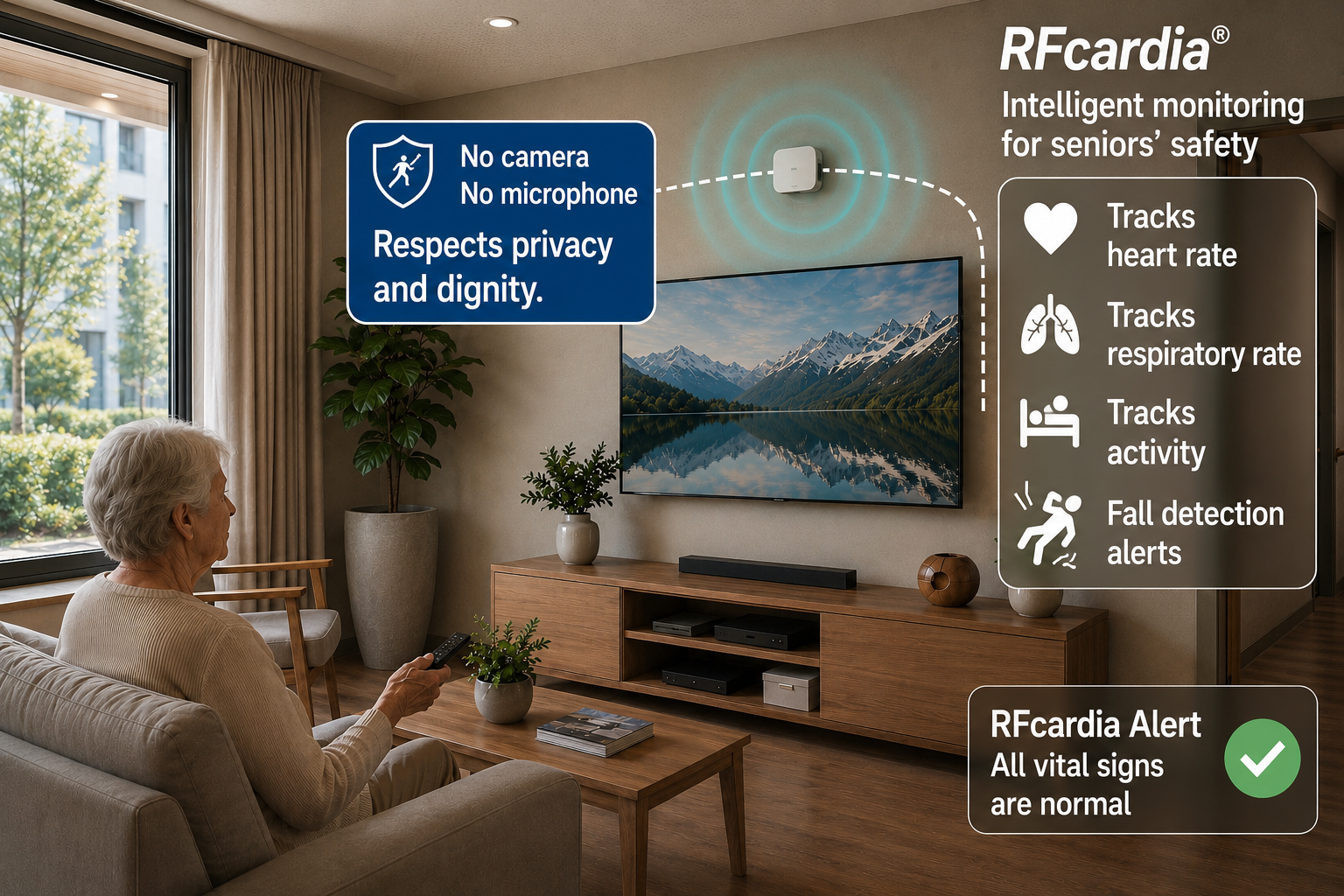
Between clinical visits, caregiver rounds and emergency situations, many fragile people remain in a silent physiological blind spot. Heart rate, respiratory rate, immobility, falls and early signs of deterioration are often not continuously observed, especially in senior living facilities, home care and hospital-at-home settings.
Existing solutions remain limited: wearables require acceptance and charging, cameras raise privacy concerns, bed sensors only work in bed, and spot-checks provide isolated snapshots. RFCARDIA aims to close this gap with a contact-free, privacy-first monitoring layer, without camera, microphone or wearable device, designed to support continuous cardio-respiratory insight while preserving dignity and comfort.
RFCARDIA is certified Deeptech by Bpifrance and selected for the French Tech Emergence Grant, strengthening recognition of its contact-free cardio-respiratory monitoring technology.
Contact-free sensing, signal processing and embedded AI work together to transform subtle cardio-respiratory micro-movements into information that can support timely, prioritized attention.
A compact RFCARDIA unit passively captures tiny thoracic micro-movements linked to breathing and cardiac activity, without anything worn, charged or actively operated by the person.
Signal processing separates weak physiological motion from noise and artefacts, extracting cleaner cardio-respiratory information while supporting richer cardio-mechanical reconstruction under development.
Embedded AI evaluates signal quality, physiological trends and abnormal patterns, combining multiple signal features to progressively support more advanced cardio-respiratory interpretation under validation.
When attention may be needed, information can be prioritized and routed to nurses, care teams, family members or monitoring platforms according to deployment needs, supporting better prioritization of limited care resources.
Advanced physiological interpretation and alerting functions are under validation.
Contact-free sensing, signal processing and embedded AI work together to transform subtle cardio-respiratory micro-movements into information that can support timely, prioritized attention.
A compact RFCARDIA unit passively captures tiny thoracic micro-movements linked to breathing and cardiac activity, without anything worn, charged or actively operated by the person.
Signal processing separates weak physiological motion from noise and artefacts, extracting cleaner cardio-respiratory information while supporting richer cardio-mechanical reconstruction under development.
Embedded AI evaluates signal quality, physiological trends and abnormal patterns, combining multiple signal features to progressively support more advanced cardio-respiratory interpretation under validation.
When attention may be needed, information can be prioritized and routed to nurses, care teams, family members or monitoring platforms according to deployment needs, supporting better prioritization of limited care resources.
Advanced physiological interpretation and alerting functions are under validation.
From senior care and home monitoring to clinical research and wellbeing experiences, RFCARDIA is designed as a flexible contact-free sensing layer for environments where passive physiological insight can add value.
Passive cardio-respiratory monitoring for elderly or fragile residents, providing an additional layer of visibility between human checks and helping care teams prioritize attention when unusual trends or prolonged inactivity may warrant review.
Multi-room visibility between human checks, with information organized for prioritized review.
Contact-free monitoring for people living independently, with information routed to family, caregivers or remote monitoring services according to deployment needs.
Home monitoring connected to the right support network.
Information routed according to deployment configuration.
A future monitoring layer between clinical visits, supporting physiological follow-up across hospital-at-home and post-acute pathways, subject to clinical validation.
Physiological follow-up between clinical visits for future HAD and post-acute pathways.
A research platform for collecting contact-free cardio-respiratory signals, benchmarking HR/RR, developing SCG-like reconstruction and preparing future validation of physiological interpretation models.
RESEARCH TARGETSCardiac, breathing and activity-derived features can be combined into a non-medical stress and relaxation indicator, enabling responsive ambient light, sound or visual feedback without cameras or wearables.
Contact-free observation of cardio-respiratory changes associated with relaxation and physiological response in non-medical environments.
Privacy-preserving sensing could support premium hospitality, spa and wellbeing experiences without cameras, microphones or wearable devices.
Information can be routed according to the care or monitoring context.
Care and clinical applications shown represent target use cases under development and validation. Wellbeing examples are non-medical and illustrative.
RFCARDIA uses contact-free RF sensing and embedded AI to capture tiny thoracic micro-movements linked to breathing and cardiac activity. The system is designed to operate passively, without camera, microphone or wearable device, and to progressively support HR/RR monitoring, SCG-like signal reconstruction and prioritized alerts under validation.
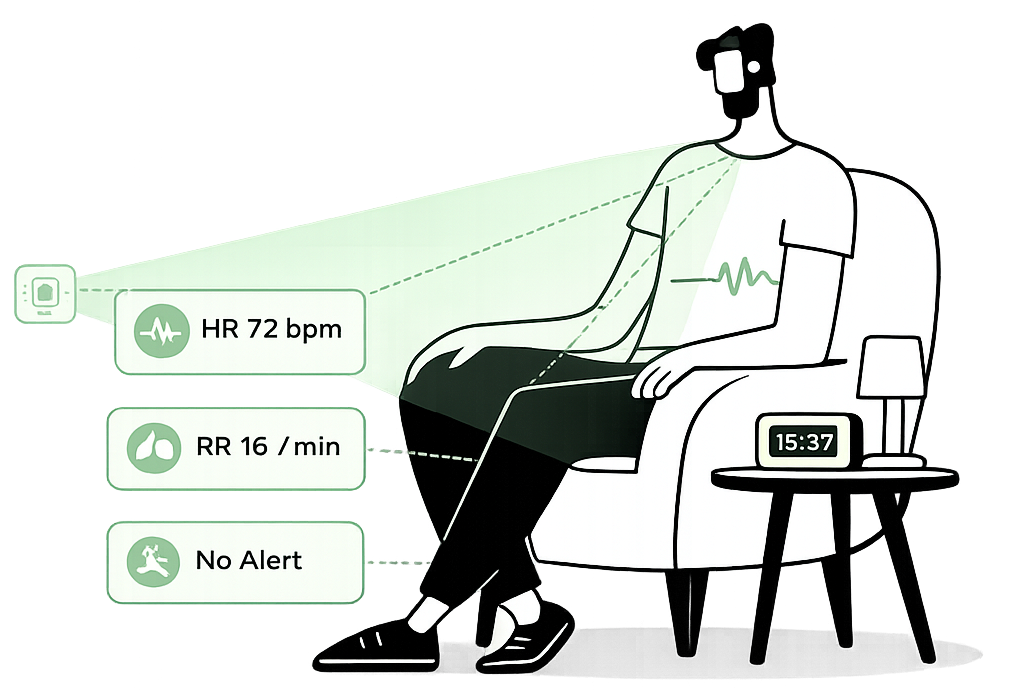
Contact-free RF sensing captures tiny thoracic movements linked to breathing and cardiac activity, without camera, microphone or wearable device.
AI-assisted processing helps follow the most informative cardiac zone and extract cleaner cardio-respiratory trends from noisy real-world signals.
Beyond HR and RR, RFCARDIA is consolidating contact-free reconstruction of cardio-mechanical signals inspired by seismocardiography.
On-device intelligence supports signal-quality assessment, artefact rejection and alert prioritization, while limiting unnecessary data transfer.
RFCARDIA brings together complementary expertise in RF sensing, weak-signal extraction, signal processing, embedded AI, software engineering and clinical framing to build a contact-free physiological monitoring solution.

Radar and RF telecom systems expert with a PhD from Université Grenoble Alpes, specialized in high-sensitivity receivers and weak-signal extraction. Inventor of the core RF technology transferred toward RFCARDIA, Jules leads the company’s strategy, partnerships, financing and first industrial deployment roadmap.

Signal-processing and instrumentation expert with a PhD from Université Toulouse III. Ashkan leads RFCARDIA’s technical development, including radar acquisition, vibration analysis and the reconstruction and validation of SCG-like cardio-mechanical signals from contact-free RF measurements.

Medical doctor and biologist, former emergency physician at AP-HP Henri Mondor, with strong expertise in semantic interoperability of health data. He supports RFCARDIA’s clinical framing, including medical use cases, alert prioritization, data structuring, claim boundaries and preparation for future clinical validation.
AI and data-engineering lead with more than 10 years of experience in predictive models, anomaly detection and industrial software deployment. Co-inventor of three patents, Reza drives RFCARDIA’s Edge AI architecture, turning radar biosignal algorithms into robust, scalable and privacy-conscious software.

RFCARDIA has been reviewed by healthcare professionals with experience in elderly care, emergency medicine, cardiology and digital health. Their feedback highlights the relevance of contact-free cardio-respiratory monitoring while helping us define responsible clinical use cases, alert boundaries and future validation priorities.
Traditional fall-detection alarms require elderly patients to press a button, which they often cannot do after a fall. A continuous, contactless system like RFCARDIA is invaluable — instantly alerting caregivers to both falls and dangerous cardiac anomalies.

"Continuous and contactless monitoring is highly relevant, particularly for elderly patients living alone. If RFCARDIA remains affordable and integrates a reliable alert system, it could stand out as a real alternative or complement to smartwatches. The potential is undeniable, provided regulatory validation is achieved.”

"Imaging provides far more relevant information than simple electrical recordings. Echography is the gold standard, but it is costly and operator-dependent. RFCARDIA has the unique potential to bring echo-like insights with the ease of ECG, and without any physical contact. If radar data can be transformed into 2D or 3D imaging, it would be a revolution in cardiology.”
RFCARDIA is developing within the French deeptech and healthcare innovation ecosystem, supported by organizations contributing to innovation financing, acceleration, medical-sector visibility and market access.

Whether you are a healthcare organization, research institution, industrial partner or investor, we would be pleased to discuss RFCARDIA’s contact-free monitoring technology, pilot opportunities and future clinical validation roadmap.